Pedestrian Accident Claims
Pedestrian accidents are among the most serious types of traffic collisions, often resulting in severe or life-threatening injuries. Because pedestrians have no physical protection, even low-speed crashes can lead to significant medical expenses, long recovery periods, and long-term disabilities.
Overview: Pedestrian Accident Claims Guide
Pedestrian accidents are among the most serious types of traffic collisions, often resulting in severe or life-threatening injuries. Because pedestrians have no physical protection, even low-speed crashes can lead to significant medical expenses, long recovery periods, and long-term disabilities. A pedestrian accident claim allows an injured pedestrian to seek compensation for injuries caused by a negligent driver. These accidents commonly occur in crosswalks, intersections, parking lots, and residential areas. In many cases, pedestrians are struck by distracted, speeding, or failing-to-yield drivers. Pedestrian accident claims often involve complex liability issues, especially when drivers claim the pedestrian was at fault. Understanding how these claims work and what evidence is needed is essential for protecting your rights and pursuing fair compensation.
What Was Actually There When They Died
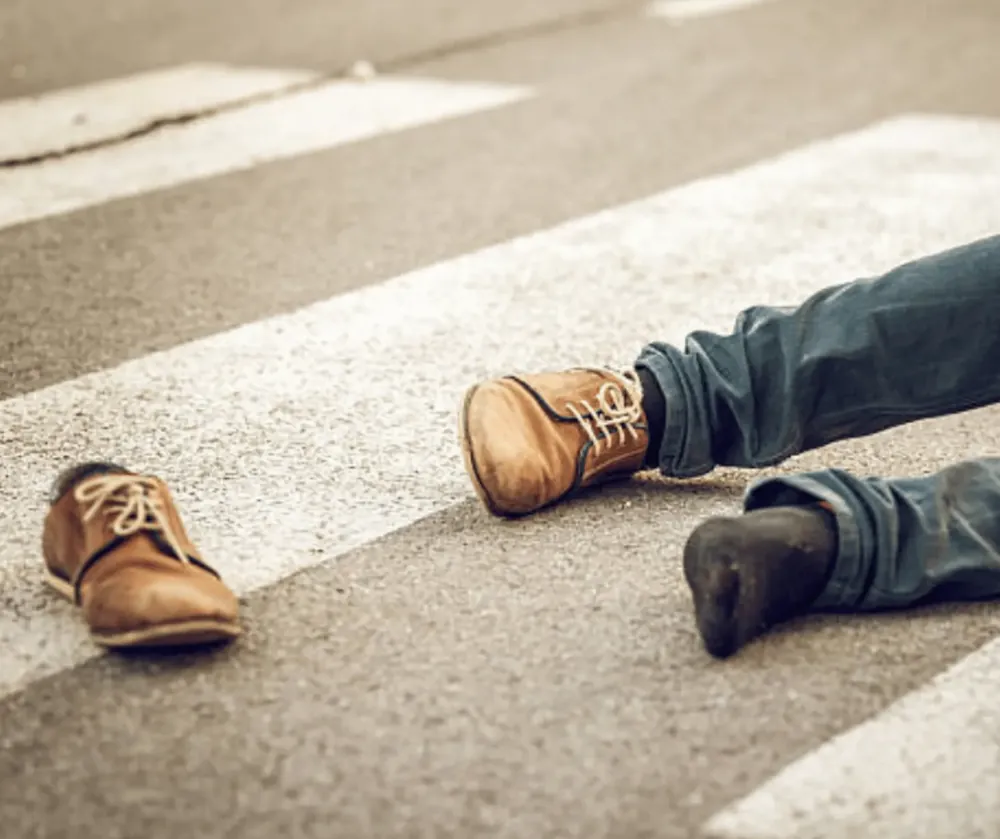
After a pedestrian is killed, the first question asked is usually what the person was doing. The federal data supports a different one: what was there for them to use.
Of the 7,524 pedestrians killed in 2024, 5,983 died where no marked crosswalk was present. In 62.3% of cases there was no sidewalk either.
None of this establishes fault. The federal file records what was physically present, not who was responsible, and crossing away from a marked crosswalk is not automatically unlawful. It is also worth saying that where there is no crossing within a reasonable distance, walking to one is not a real option. The full analysis is published as There Was No Crosswalk.
The Lighting Finding Everyone Gets Backwards
Three quarters of these deaths happen in darkness, which is widely known. The part that gets missed is the split inside that number.
More pedestrians were killed on roads that were lit (2,998) than on roads that were not (2,495). The standard response to a night-time pedestrian death is to call for street lighting. Lighting is worth having. But these deaths are not concentrated on unlit roads, and presenting lighting as the fix does not match the data.
A fair caveat: lit roads also tend to be busier roads, and this is a comparison of raw counts rather than deaths per mile walked. The honest reading is not that lighting makes things worse. It is that lighting alone is not sufficient, and that a lit road can still be a road nobody designed for people to cross.
Older Pedestrians Die in a Different Place
Splitting the crosswalk figure by age produces the most uncomfortable result in the analysis.
Among 15-24 year olds, 88.4% of those killed died away from any marked crossing. Among people aged 65+, that falls to 67.4%. Turned around: about 32.6% of older pedestrians killed died inside a marked crosswalk, a far higher share than any younger group.
The likeliest explanation is behavioural rather than mysterious. Older pedestrians are the group most inclined to walk to a marked crossing and use it. The finding is that doing so did not protect them. Crossing speed is part of it, since signal timings assume a walking pace many older people cannot maintain, and so is the fact that a painted crossing without a signal relies entirely on a driver choosing to stop.
How Pedestrian Claims Actually Work
Pedestrian cases differ from vehicle collisions in ways that matter from the first day.
The injuries are more severe. A person on foot has no crumple zone, no airbag and no seatbelt. The same impact speed that leaves a driver shaken can leave a pedestrian with multiple fractures, a brain injury, or worse. That drives both the medical cost and the length of recovery.
Fault is contested more often. Because the pedestrian is usually the only person injured, the driver and their insurer have both the incentive and the opportunity to describe events in their own terms. Whether a marked crossing existed, whether a signal was in the walk phase, and whether the pedestrian was visible all become disputed points.
Shared fault rules vary by state and can matter enormously. Some states reduce recovery in proportion to the pedestrian's share of responsibility; others bar recovery entirely past a threshold. This is one of the clearest examples of a case where where it happened changes what happens. Our state guides cover those differences.
Evidence that tends to decide pedestrian cases
- Whether a marked crosswalk or signal was present, and its condition
- Street lighting at the location and whether it was working
- Vehicle speed, braking and any onboard or dashcam data
- CCTV or doorbell footage from nearby premises, which is often overwritten within days
- The police report and any scene measurements
- Medical records establishing the injuries and their progression
That fourth item is the one people miss. Private camera footage is frequently the best record of what happened, and it is also the most perishable: many systems overwrite within a week or two.
If You or a Family Member Were Hit While Walking
- Get medical attention and keep going back. Gaps in treatment are the single most common argument an insurer makes that an injury was not serious.
- Record the location precisely. Whether there was a crossing, where it was, whether the lights worked, and what the road looked like. These are exactly the facts that get disputed later.
- Ask about nearby cameras quickly. Shops, homes and buses near the scene may hold footage, and most systems overwrite it.
- Get the police report number and the investigating agency.
- Be careful with recorded statements. You are not obliged to give one to another party's insurer before you understand your position.
- Act promptly. Every state sets its own filing deadline, and shorter notice periods can apply where a city or public authority is involved. The evidence clock usually runs faster than the legal one.
You can estimate what a claim like yours may involve with our settlement calculator, or read the data behind this article in our pedestrian crossings study.
Figures on this page come from our analysis of the NHTSA Fatality Analysis Reporting System 2024 national file. Cyclists are counted separately from pedestrians throughout: a further 1,102 cyclists were killed in the same year. Cash4Crashes is a lead-generation service that connects people injured in crashes with attorneys in our network. We are not a law firm and nothing on this page is legal advice.
Were you injured in a Pedestrian Accident Claims?
Get a free case evaluation from an experienced attorney today.
Types of Pedestrian Accident Claims



Injured in a Pedestrian Accident Claims? We Can Help.
Our network of experienced attorneys has recovered millions for car accident victims. Get your free case review today.

